



Why Transparency Matters in Liquor Packaging
Transparency in liquor packaging is more than just a matter of sight; it stands for honesty, quality control, and brand loyalty. When talking about a Whisky Glass Bottle, "transparency" can mean both the physical properties of clear borosilicate glass and the moral aspect of showing that a product is real. Modern customers and B2B buyers value packaging that shows off the liquid inside without hiding it, so they can judge the quality right away. Clear glass bottles show that you trust the quality of the product and let brands use the natural amber or golden colors of high-end drinks as marketing tools.
Understanding Transparency in Liquor Packaging
The Evolution from Opacity to Clarity
In the past, companies that made drinks liked to use dark green or brown glass bottles to keep the contents safe from light damage. During the 1800s and early 1900s, this sensible method was the most common way to package whisky. The move toward clear packing began when high-end brands realized that clear glass could do two things: protect the purity of the liquid by choosing the right material and show off the quality of the product at the same time. Newer borosilicate glass technology has better formulations that address earlier worries about UV exposure. This lets brands use clear glass without affecting the shelf life. This change shows how market standards are changing, where visibility now means premium placement instead of risk.
Material Choices and Their Impact on Transparency
Choosing the right glass materials has a direct effect on how well the package works. Because it is so clear, doesn't react with chemicals, and can withstand high temperatures, borosilicate glass has become the best choice for fine spirit packing. Borosilicate glass, unlike regular soda-lime glass, keeps its shape even when the temperature changes, which is very important for thermal transfer printing. There are options to lead-based crystals that are just as bright and meet the strict safety standards set by the FDA and EU. The choice of material affects not only how it looks, but also how quickly it can be made, how often it breaks on high-speed filling lines, and how stable it is over time when stored for reference samples in distilleries.
B2B Advantages of Transparent Packaging
Brand leaders and procurement managers know that clear glass packaging, such as a Whisky Glass Bottle, has real business benefits. Transparent bottles lower the cost of identification by letting you check the quality visually without having to open sealed items. In stores, clear containers make the shelves stand out more because they create visual depth that draws customers' attention better than opaque ones. Travel retail businesses value openness when it comes to letting customers know that a product is real, especially in duty-free areas where faking is common. Hotels, restaurants, and cafés in the horeca channel use clear bottles to make dramatic back-bar displays that support brand stories through visual merchandising.
Key Factors to Consider When Choosing Transparent Whisky Glass Bottles
Capacity and Dimensional Specifications
The standard sizes for spirit bottles are 100ml, 250ml, 500ml, and 750ml. Each size is best for a different type of customer or way of distributing the product. The 750ml size is still the standard for selling whisky in stores around the world. It's the best size for both consumers and retailers in terms of saving room on shelves. Smaller 100ml and 250ml sizes are available for flight miniatures, special samples, and new trends in single-serve drinking. Dimensions of a bottle include more than just its volume. They also include the neck finish, shoulder angles, and the weight of the base slug. These dimensions affect the label's surface area for application, how valuable it seems because of its weight, and how well it works with automatic corking equipment on production lines.
Material Quality and Regulatory Compliance
Borosilicate glass manufactured in Cangzhou, Hebei province, meets international standards for food-contact safety by having the right amounts of silica, boron oxide, and alumina. To prove compliance, you need proof that the amounts of lead and cadmium are below the limits set by FDA 21 CFR 177.1480 and EU Regulation 10/2011. Quality assurance procedures should include checking the heating to make sure it doesn't break on its own due to temperature stress, testing the hydrolytic resistance to make sure the surface is stable, and testing the vertical load compression for shipping on pallets. The specs for buying something must include the accepted failure rates for things like seeds, stones, and cords that look bad but don't affect the optical clarity.
Customization Capabilities for Brand Differentiation
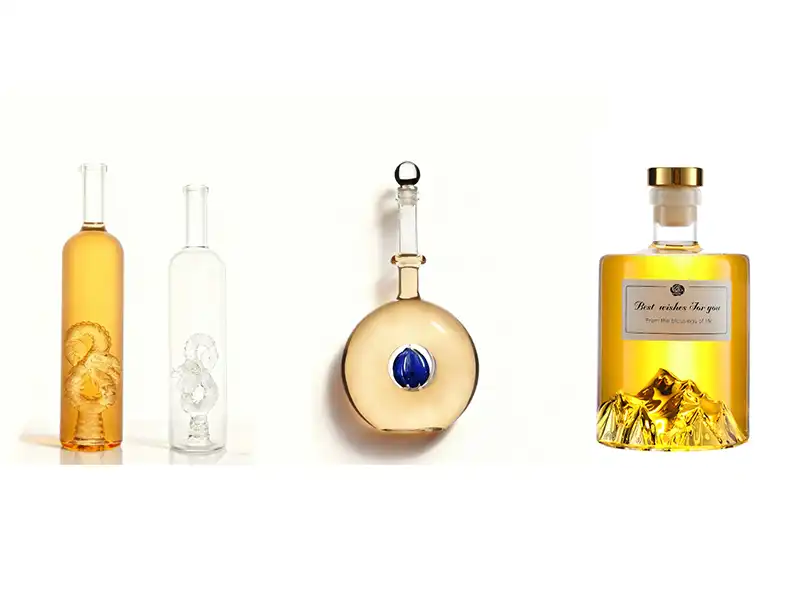
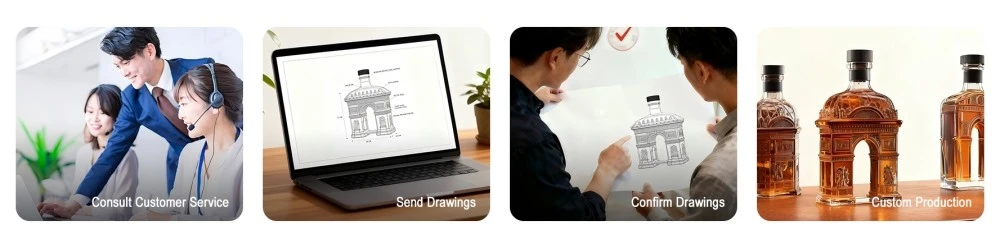
Private mold creation lets brand owners make their own bottle designs that can be used as three-dimensional logos. As part of customization, you can use techniques like debossing to create minor surface depression effects and complex geometric changes to standard cylindrical shapes. Embossing creates physical brand elements. Frosting, gradient color painting, and shiny electroplating are some of the surface treatments that can be used to turn clear glass into a multisensory brand experience. With thermal transfer printing, you can make images with a lot of colors and photographic detail that you couldn't get with screen printing alone. Different glass lid methods, like cork-finished stoppers or ground glass closures, make the product more useful and support its high-end standing.
Procurement Insights: How Transparency Influences B2B Purchasing Decisions?
Supplier Evaluation Criteria
To choose a Whisky Glass Bottle maker, you need to carefully look at their success in several different areas. Verification of production capacity should prove that the yearly output capacity is more than three million units to make sure that scaling brands can keep getting their products. Operations that started in 1992 show that the company has been making things for decades, which means they have a lot of process knowledge that leads to regular quality results. International trade skills that can be proven with proof like being a nine-year Alibaba Gold Supplier and having exported to over fifty countries, show that the company is reliable in terms of logistics. Delays in the product development cycle that cost a lot of money can be avoided by having technical engineering tools that can support the whole design-to-delivery process.
Bulk Ordering Economics and Custom Order Advantages
When you ship between 10,000 and 500,000 pieces per shipment, volume-based price systems save you a lot of money. Economies of scale happen when molds are used over and over again for longer production runs, setup costs are lower per unit, and containers are loaded more efficiently, which lowers freight costs. When the expected lifetime output goes over 100,000 pieces, investing in a custom mold makes economic sense.
This makes bottle architecture a defendable brand asset. Long-term supply deals with yearly promises make it easier to plan production, which keeps prices stable and makes sure that capacity is allocated during times of high seasonal demand. Brand owners and manufacturing partners will have the same goals if they are paid based on design worth and equipment investment instead of just unit price.
Logistics and Protection Strategies
Transportation problems with glass boxes are unique and need special handling procedures. Corrugated dividers, corner guards, and box stabilization systems are all parts of export-grade packing solutions that keep loads intact during intermodal shipping. To keep breaking rates below 0.5%, filling patterns for containers must take into account how the weight is distributed and how to dampen vibrations. For international packages, it's important to have the right HS code classification, proof of place of origin, and food-contact material certificates to make clearing customs easier. Protective measures include hiring freight forwarders who know how to handle fragile items and getting marine cargo insurance with coverage levels that match the value of the item and the cost of replacing it.
Enhancing Brand Trust and Customer Experience Through Transparent Packaging
Transparency as a Quality Signal
Clear glass packaging is an unstated quality promise that works for both businesses and consumers. When distillers put high-end old spirits in clear bottles, they show that they are sure that a visual inspection will back up their quality claims. This choice of packing is especially strong for craft makers and independent bottlers whose brand value depends on how real their products are seen to be. Transparency stops people from changing colors by making them obvious, which protects the purity of the group. Procurement managers who want to put their products in high-end categories know that clear packing makes their goods more appealing to quality-conscious shoppers who want to see proof.
Storytelling Through Design Elements
Through raised crests, etched production dates, and relief patterns that look like they belong in old buildings, heritage companies use clear bottles to tell brand stories. Modern craft makers use simple, clear patterns that stress the purity of the liquid and the openness of the production process as brand values. With custom molds, you can insert famous images, like mountain ranges, landmark buildings, or cultural symbols, directly into the design of the bottle. This makes a real link between the product and its origin. These story-like elements turn useful packaging into valuable things that can also be used as decorations, spreading the brand's presence from times of consumption to home settings.
Strategic Deployment Across Sales Channels
The efficiency of transparent packaging changes depending on where it is distributed, so it needs to be optimized for each route. Clear bottles are good for e-commerce sites because they take good pictures that don't need much editing. This cuts down on the cost of visual marketing and sets realistic standards for customers. Retailers in real life use the way that clear packaging bends light to create drama on the shelves by carefully lighting the items. In bars and restaurants, clear bottles are used for dramatic pours and back-bar displays that make the brand more visible throughout the service experience. As high-value gifts that keep people interested in a brand after they've bought something, customized clear bottles with event-specific names and theme patterns are used in promotional activities and special releases.
Maintaining and Optimizing Whisky Glass Bottles for Longevity and Performance
Preservation and Cleaning Best Practices
To maintain the visual clarity of clear borosilicate glass in a Whisky Glass Bottle, it needs to be cleaned in a way that does not damage the surface. As long as the temperature and concentration stay within certain ranges, alkaline detergent solutions can clean lipid leftovers and label glue without scratching glass surfaces. To keep micro-scratches from building up and making the surface less clear over time, mechanical cleaning systems must adjust the strength of the brushes and the quality of the water used to rinse. Controlled humidity settings are recommended for storage because they stop moisture from condensing between the liquid and the closure, which can weaken the seal and open up pathways for oxidation.
Avoiding Common Procurement Pitfalls
Several common mistakes hurt the performance of packing and how people see the company. When transportation planning, if you don't take into account how fragile glass is, you'll end up with too many broken items, which cuts into profits and delays product launches. If you only look at the unit cost of cheaper glass materials, you may end up with measurement errors that stop the production line during automatic filling operations. When mold design investments aren't enough, bottles are made with walls that aren't all the same thickness. This makes stress concentration places that can be damaged by heat shock during the pasteurization process. Not stating the annealing standards leads to residual stress that shows up as random breaking weeks after the first quality check, which leads to costly return situations.
Future Innovations in Transparent Packaging
New technologies have the potential to make clear spirit packages more eco-friendly and useful. By optimizing geometry and stress distribution models, lightweight glass formulas cut the amount of material needed by 15 to 20 percent while keeping the structure's integrity. Bio-based glass layers protect against UV rays without affecting the clarity of the glass. This fixes the problem of having to choose between clarity and light stability in the past. More post-consumer recycled material is being added to luxury glass formulations as a result of circular economy efforts. This helps meet environmental goals without affecting the quality of the glass's optics. Smart package features, like NFC tags and QR codes laser-etched into bottle bottoms, make it possible to authenticate products, track the supply chain, and interact directly with customers through clear glass surfaces.
Conclusion
Transparency in liquor packaging isn't just a matter of personal taste; it's also a matter of quality assurance, brand identity, and building trust with customers. Material science concerns, customization options, and logistical facts of B2B buying systems must all be balanced when choosing the right clear packaging. Borosilicate glass bottles made to meet international safety standards have the clear vision, stable temperature, and chemical inertness needed to show high-end spirits.
As the market values authenticity and visual effect more and more, brands that invest in clear packaging, such as Whisky Glass Bottle, will have a long-term economic advantage across a wide range of distribution platforms and geographic markets.
FAQ
How do I verify that a Whisky Glass Bottle supplier meets international safety standards?
Ask for a lot of paperwork, like material safety data sheets (MSDS), reports from independent labs that say the amount of lead and cadmium is below FDA and EU limits, and ISO 9001 quality management approval. Manufacturers with a good reputation give you access to their production facilities for a check to make sure you did your research. They also provide migration testing results that show they follow food-contact laws.
What distinguishes whisky bottles from decorative decanters in procurement specifications?
Standardized neck finishes that work with commercial closing systems, regular wall thicknesses that work with production lines, and dimensional specs that are best for automatic filling equipment are all things that bottles have. Decanters put an emphasis on aesthetics by using asymmetric designs, hand-blown workmanship, and artistic stoppers that make the product look better at the cost of making it less efficient.
Are eco-friendly transparent bottle options viable for large-scale production?
Twenty to forty percent post-consumer recovered glass is used in modern production without affecting the glass's clarity or strength. Lightweight designs leave less of a carbon footprint because they use less material and produce fewer fumes during shipping. Choosing sources with solar-powered facilities and heating furnaces that use less energy is another way to show care for the environment while still keeping up the production levels needed for businesses.
Partner with a Trusted Whisky Glass Bottle Manufacturer
Jiateng has specialized in premium spirit packaging solutions since 1992, serving renowned brands like Xifeng Wine and Wuliangye with annual production exceeding three million bottles. Our borosilicate glass bottles—available in 100ml, 250ml, 500ml, and 750ml capacities—combine exceptional clarity with thermal transfer printing compatibility and full OEM/ODM customization. With fifteen years of international trade expertise and engineering teams offering comprehensive design-to-delivery support, we transform your brand vision into distinctive packaging assets. Contact our specialists at lhd513@jtblzp.com to discuss your requirements with a reliable Whisky Glass Bottle supplier committed to quality, innovation, and partnership success.
References
1. Robertson, Gordon L. Food Packaging: Principles and Practice, Third Edition. CRC Press, 2012.
2. Marsh, Kenneth and Betty Bugusu. "Food Packaging—Roles, Materials, and Environmental Issues." Journal of Food Science, Vol. 72, No. 3, 2007.
3. Brody, Aaron L. and Kenneth S. Marsh, editors. The Wiley Encyclopedia of Packaging Technology. John Wiley & Sons, 1997.
4. Yam, Kit L., editor. The Wiley Encyclopedia of Packaging Technology, Third Edition. John Wiley & Sons, 2009.
5. Selke, Susan E.M., John D. Culter, and Ruben J. Hernandez. Plastics Packaging: Properties, Processing, Applications, and Regulations. Hanser Publications, 2004.
6. Piergiovanni, Luciano and Sara Limbo. Food Packaging Materials. Springer International Publishing, 2016.